Design Concepts: Hawthorne Avenue Pedestrian and Bicycle Crossing
EXISTING CONDITIONS
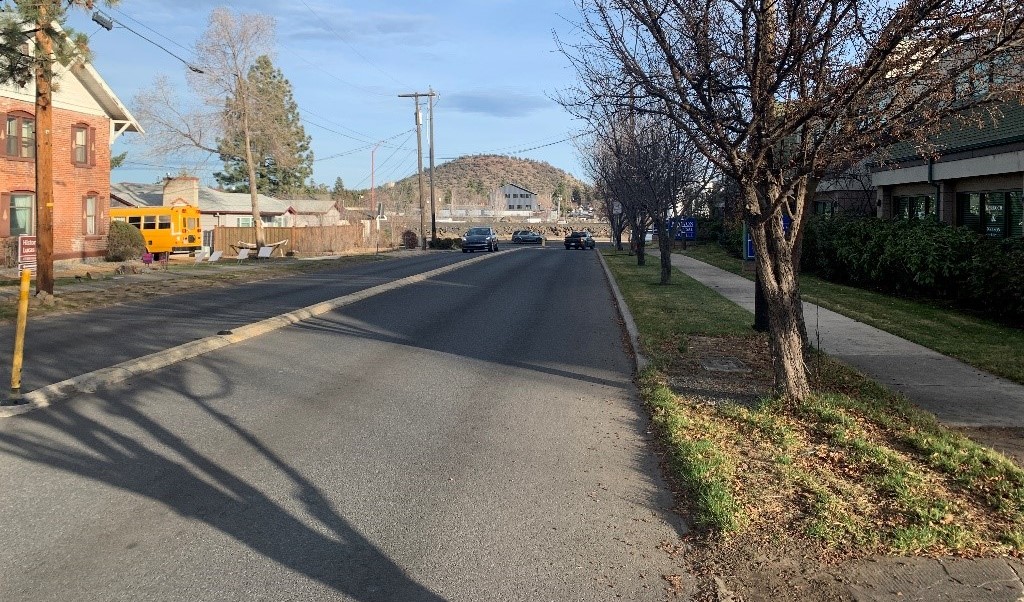
Currently Hawthorne Avenue does not cross US 97 (Bend Parkway) and the BNSF railroad. However, the City’s Transportation System Plan (TSP) and Core Area Project (CAP) that included extensive public outreach and engagement identified that a new pedestrian and bicycle crossing at this location could support community goals for future urban housing and employment needs. An investment at this location also presents an opportunity for the NE 3rd Street commercial strip and nearby industrial area to transition to a mixed-use area where people can live, work and play. Finally, constructing an entirely new crossing here versus modifying the existing ones at Greenwood and Franklin may be quicker to implement in the near term, depending on the design chosen and cost.
HAWTHORNE DESIGN CONCEPT 1: Bridge with Long Ramps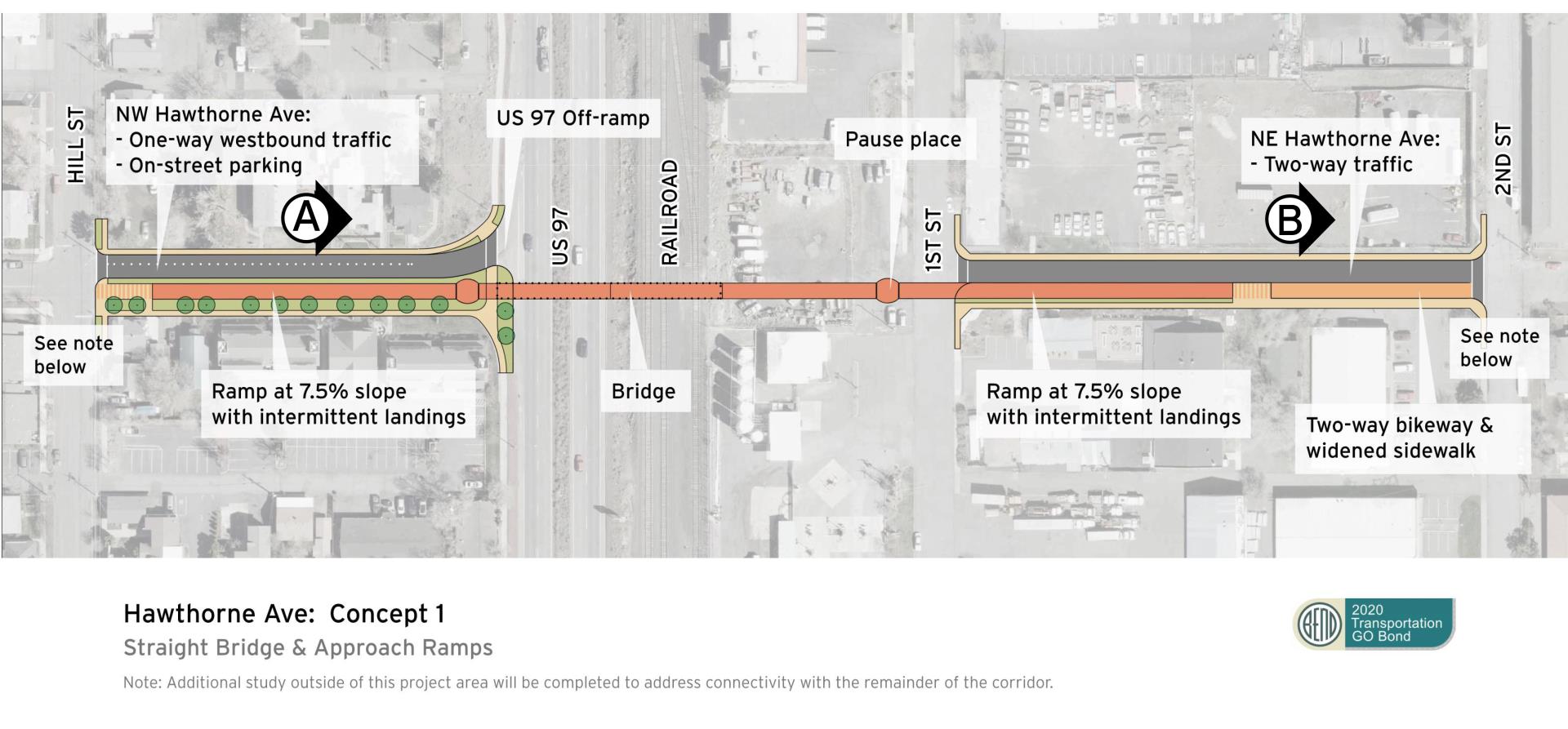
Select the letter below to view the roadway area cross section:


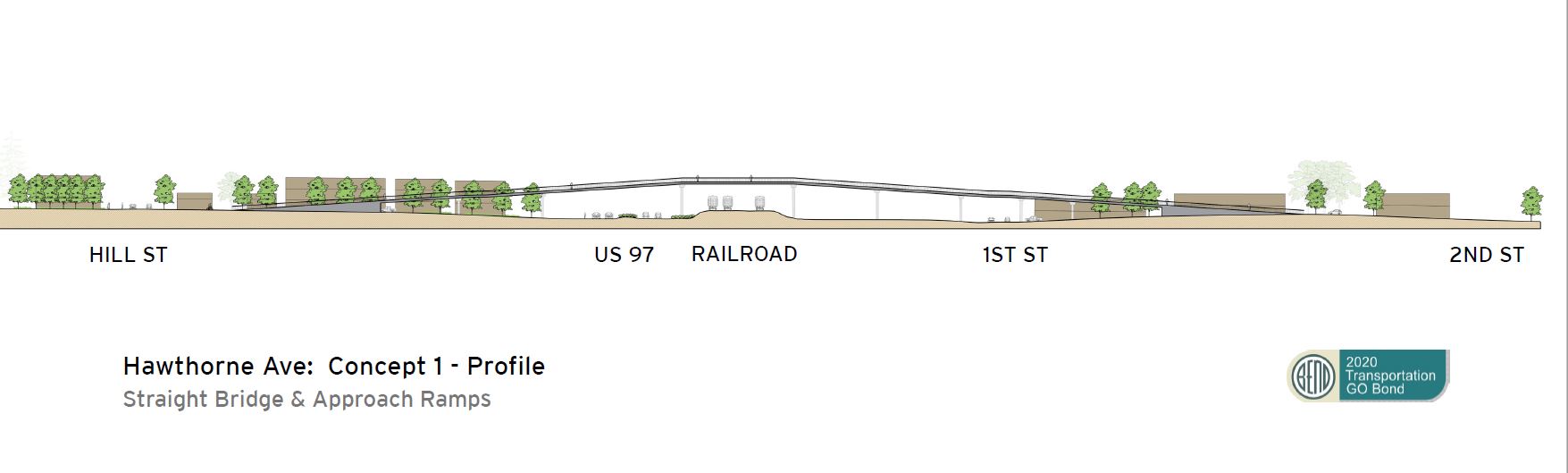
This design concept features a bridge with long ramps located on the south side of Hawthorne Avenue. To accommodate a bridge tall enough to span U.S. 97, the ramps will include slopes up to a 7.5% grade – that means the ramps will rise seven feet every 100 feet – with a few landings to rest or slow wheels. The west ramp stops short of NW Hill Street and allows for a flat area before the intersection. The east ramps end at the high point on Hawthorne Avenue.
LEVEL OF IMPROVEMENT, COST AND TIMELINE
- Level of Improvement: Significant. This concept provides a simple and direct route for people walking and bicycling and meets accessibility requirements.
- Cost: High. Initial assessments put this in the low-range of possible Hawthorne Crossing concepts.
- Timeline: Moderate. The moderate cost could allow the City to move forward with secured funding and implementing improvements faster.
BENEFITS
- Clear direct route for people walking and bicycling.
- Establishes universal accessibility.
- No blind spots for bridge users.
- Opportunity for views in all directions from bridge deck.
- The elongated bridge and ramps create more opportunities for a creative and iconic design, and a sleek and minimalist structure.
- No stairs or elevators required.
- Minimal maintenance.
- The 7.5% ramp grade with landings will help slow down bicyclists.
- Least expensive Hawthorne Crossing option without elevators.
- The west ramp utilizes space freed up by a proposed closure of the U.S. 97 entrance access (U.S. 97 exit access to remain open)
DRAWBACKS
- High railroad clearances require long ramps.
- Ramp structure obstructs views at the street level from properties along NW Hawthorne Avenue between NW Hill Street and NW Second Street.
- East ramp eliminates parking on both sides between NW 1st Street and NW 2nd Street.
- Some vehicle access to properties along the west side of NW Hawthorne Street may be impacted or eliminated.
- The ramp grade at 7.5% with landings might be more difficult to climb for some users.
HAWTHORNE DESIGN CONCEPT 2: Bridge with Switchback Ramp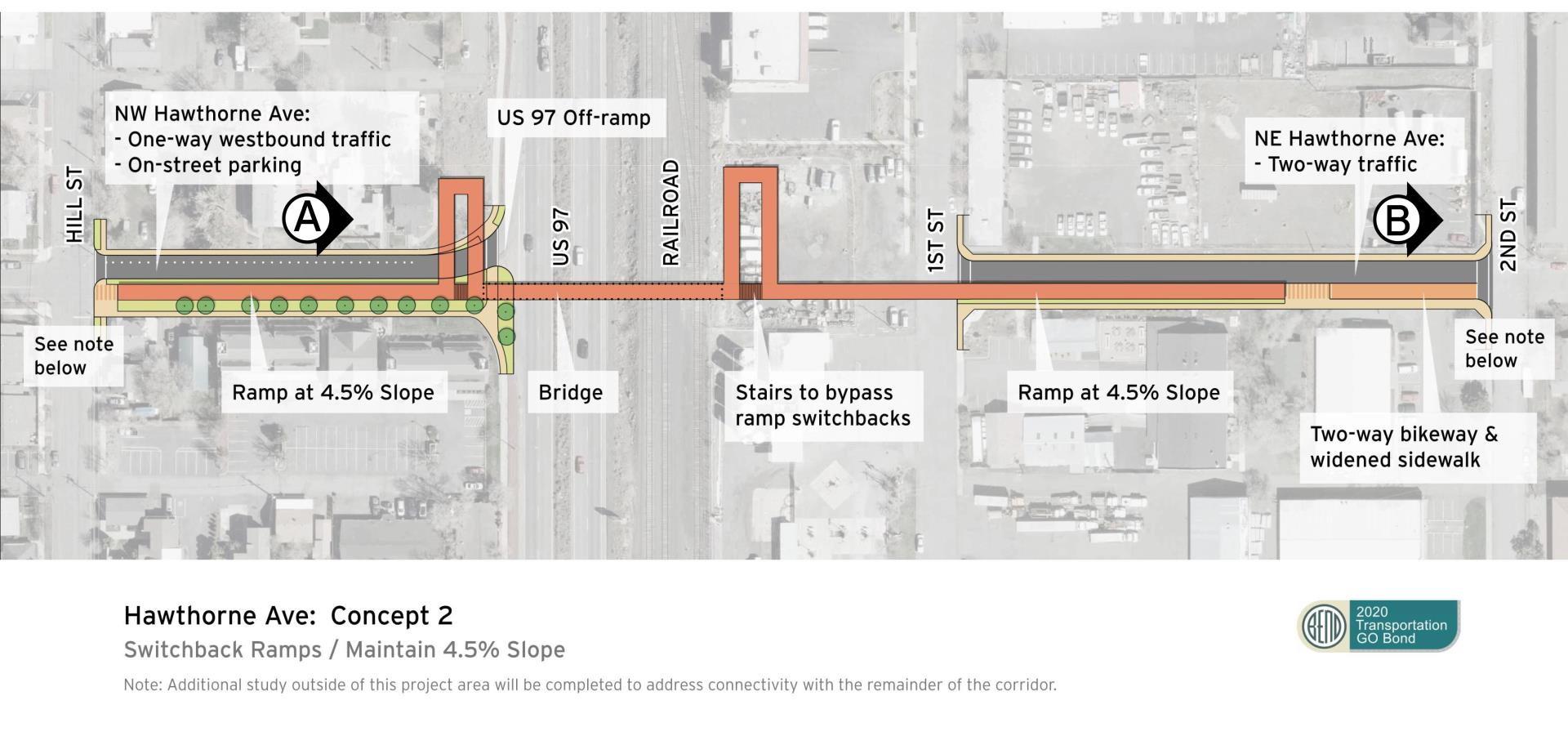
Select the letter below to view the roadway area cross section:
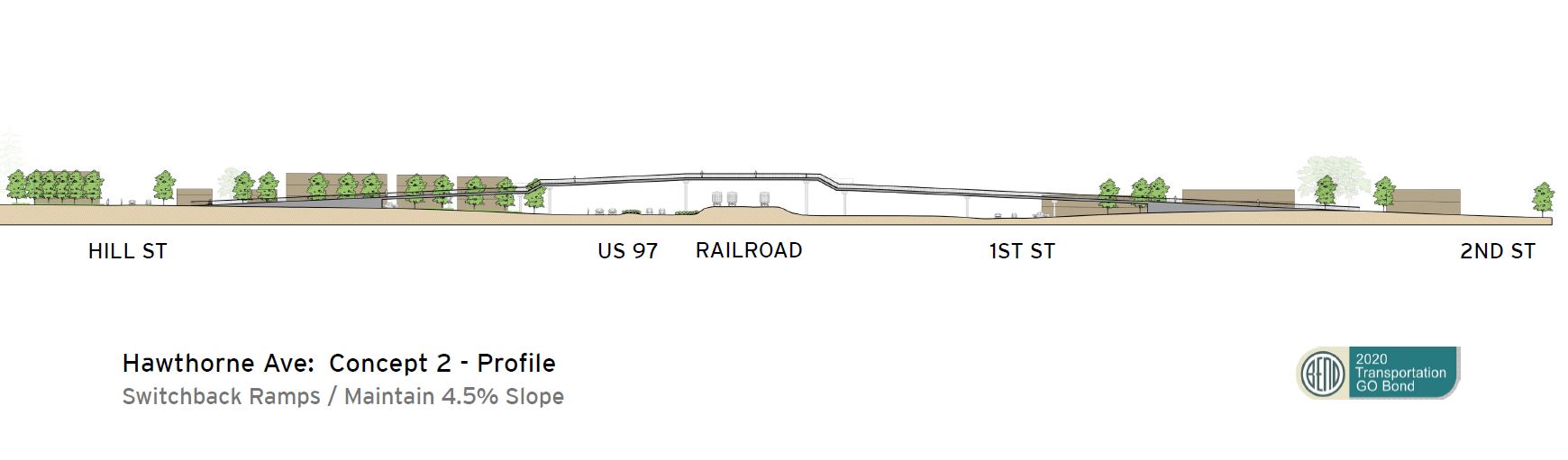
The “Bridge With Switchback Ramps” is like the “Bridge with Long Ramps” Concept, but it features ramps with switchbacks for a more comfortable slope – or 4.5% grade. This design might be able to accommodate stairs between the switchback loops to allow people walking to bypass the switchbacks.
The west ramp would be routed onto the City-owned property and back to the south side of NW Hawthorne Avenue. The proposed ramp location would not impact ODOT’s ability to lengthen the deceleration lane for the U.S. 97 exit to Hawthorne Avenue in the future.
LEVEL OF IMPROVEMENT, COST AND TIMELINE
- Level of Improvement: Significant. This concept provides a more complex but direct route for people walking and bicycling and meets accessibility requirements. The slope of the approach ramps is more gradual and comfortable for users.
- Cost: High. Highest of three Hawthorne Crossing concepts.
- Timeline: Significant. The cost may require more time for the City to fully fund, design and construct the bridge.
BENEFITS
- Clear direct route for able-bodied pedestrians.
- Establishes universal accessibility.
- Opportunity for views in all directions from bridge deck.
- Ramp slopes are more gradual (approximately 4.5%).
- No elevators required.
- Stairs at switchbacks provide a direct route for some users.
- The west bridge ramp utilizes street space freed up by a proposed closure of the U.S. 97 entrance (U.S. 97 exit access to remain open).)
DRAWBACKS
- High railroad clearances require extensive ramping and longer travel distance for users unable to use stairs.
- The ramp structure will obstruct street-level views from some properties along NW Hawthorne Avenue between NW Hill Street and NW Second Street.
- Ramps and switchbacks will block views across the street and U.S. 97.
- Switchbacks create a bulkier structure that will be visible from U.S. 97 and may detract from the signature look of the bridge.
- Snow removal on stairs is more difficult.
- East ramp eliminates parking.
- Existing vehicle access to properties along the west side of Hawthorne Avenue may be impacted or eliminated.
HAWTHORNE DESIGN CONCEPT 3: Bridge with Stairs and Elevator Access (No Ramps)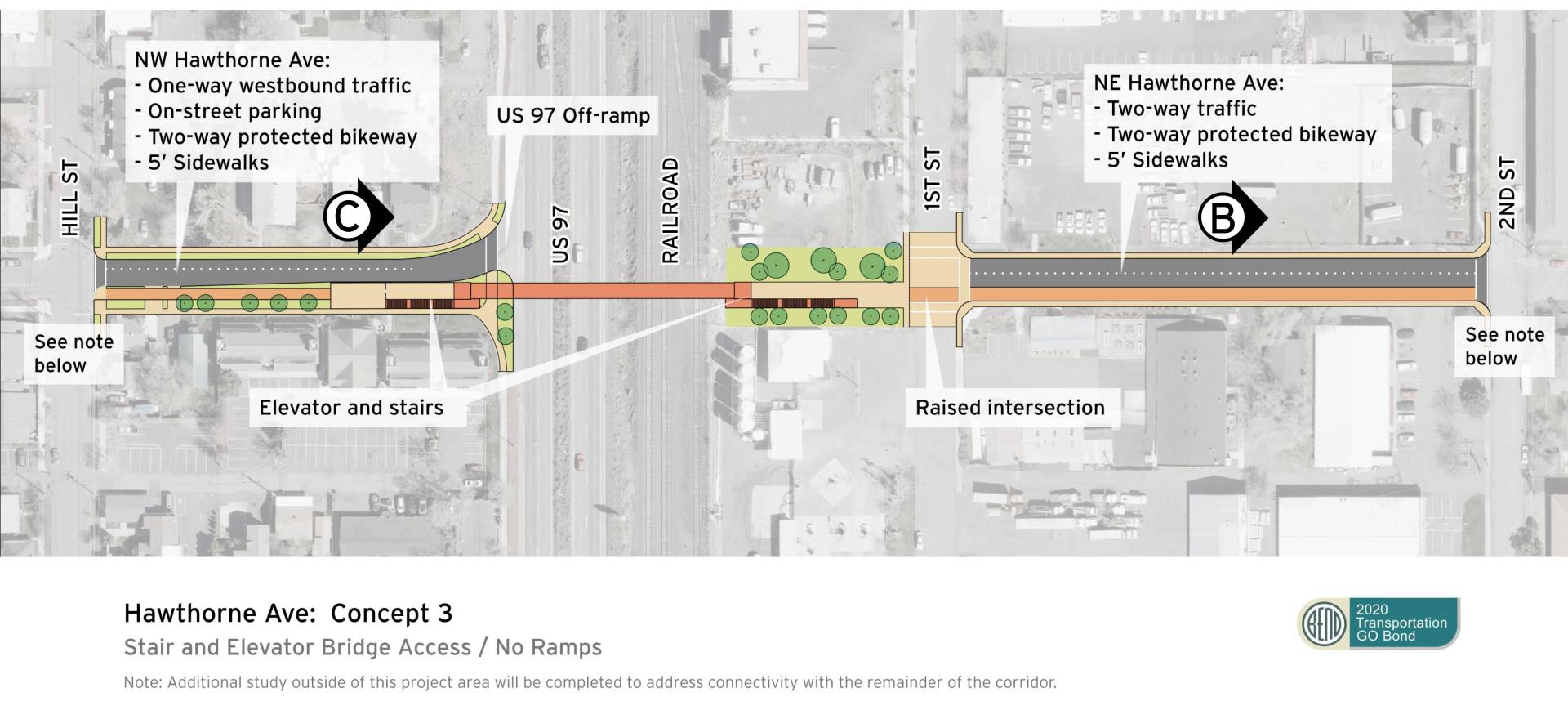
Select the letter below to view the roadway area cross section:

The “Bridge With Stairs and Elevator Access (No Ramps)” concept features an elevator and stairs but does not include ramps. This allows the potential for the development of a plaza area between the elevator and NE 1st Street and a multi-use path on the south side of Hawthorne Avenue between NE 1st Street and NE 2nd Street.
The elevator and stairs would be located close to the railroad and ODOT’s Right-of-Way. The approach to the elevator on the west side of U.S. 97 would slope up to create a vertical separation between the highway deceleration lane and the multi-use path approaching the elevator.
LEVEL OF IMPROVEMENT, COST AND TIMELINE
- Level of Improvement: Significant. This concept provides a direct route for people walking and bicycling with the use of stairs and an elevator.
- Cost: High, but the middle of the three Hawthorne Crossing concepts.
- Timeline: Significant. While the cost is estimates as the middle of the bridge alternatives, the City would need time to fully fund, design and construct the bridge.
BENEFITS
- Establishes a clear route for access that the community can easily understand.
- Establishes universal accessibility.
- Provides clear and safe connections.
- Utilizes the smallest footprint to accommodate the crossing.
- Minimal roadway impacts during construction.
- No visual obstruction from ramp structure; preserves the street character and sightlines from properties along Hawthorne Avenue between NW Hill Street and NW 2nd Street.
- Lower anticipated construction costs.
- Gives opportunity for a higher main span elevation if this is advantageous for views from the bridge and/or signature bridge design.
DRAWBACKS
- Requires long-term elevator maintenance and repairs.
- Personal safety and sense of security concerns because of enclosed spaces or blind spots at stairs and elevators.
- Snow removal on stairs and bridge is more difficult.
WHAT YOU NEED TO KNOW
- Concept 1: Bridge with Straight Ramps. The cost of this concept is expected as the lowest of the bridge options. Ramps will be shorter than Concept 2 and therefor will be steeper and might be more difficult for some users.
- Concept 2: Bridge with Switchback Ramps. This is the most expensive of the alternatives but increases the length of the ramps and reduces the slope making the climb easier for some users.
- Concept 3: Bridge with Stairs and Elevator Access (No Ramps). Cost for this concept is anticipated to be between Concept 1 and 2. This concept is the smallest footprint of the three concepts but will require people to use the stairs or take an elevator.
- All concepts: Additional work is still needed beyond this feasibility study to ensure connectivity for safe walking and bicycling from surrounding neighborhoods to this crossing to connect Juniper Park to Downtown.
All three concepts may require additional time to fully fund, design and construct.
Tell us what you think.
